
TL;DR
Open a free Amazon Business account
Business pricing, bulk buying and tax-exempt orders.
Create a free accountAs an affiliate, we earn on qualifying purchases.
Oven dials often mislead by as much as 20°F, causing uneven cooking. Regularly check your oven with a thermometer and calibrate it if needed to get consistent, accurate heat for your recipes.
You’ve probably noticed it—your cake comes out a bit flat or your roast isn’t as tender as it should be. The culprit? Your oven dial. Many built-in oven gauges are inaccurate, drifting from the real temperature by dozens of degrees. This mismatch can turn a perfect recipe into a kitchen disaster without you knowing it.
In this guide, you’ll learn exactly how to test whether your oven’s temperature is true, what tools to use, and how to fix it if it’s off. Because when your oven’s heat is right where it should be, baking and roasting become straightforward, predictable, and—dare I say—fun.
Oven dials can be off by as much as 20°F, leading to uneven cooking.
Regularly testing your oven with a quality thermometer reveals the true temperature.
Calibration adjusts your oven’s internal sensor, improving accuracy without replacement.
Investing in a digital oven thermometer provides ongoing, reliable temperature monitoring.
Perform an annual check to keep your oven cooking predictably and perfectly.
Why Your Oven Dial Lies (And How Big the Problem Is)
Most oven dials are mechanical or electronic sensors that can drift over time. That means when you set your oven to 350°F, it might actually be running at 330°F or 370°F. According to an anonymous researcher, many ovens can be off by as much as 20°F, sometimes more, especially as they age or if they haven’t been calibrated.
Imagine baking a batch of cookies expecting a golden crust at 350°F, only to find them slightly underdone because your oven was actually at 330°F. Or roasting vegetables that burn on the outside but stay raw inside because the oven hits 370°F instead. The discrepancy isn’t just annoying—it’s a real obstacle to consistent cooking.
Understanding this disconnect is the first step. Your built-in dial is a rough guide, not a guarantee. So, how do you get the real story? Let’s look at how to check your oven’s true temperature.

Hotloop Digital Oven Thermometer Heat Resistant up to 572°F/300°C, LCD
- Easy-to-Read LCD Display: Displays actual oven temperature clearly
- High Temperature Accuracy: Measures 32~572°F with ±1.8°F precision
- Simple Setup and Use: Probe fits through oven door or grill lid
As an affiliate, we earn on qualifying purchases.
As an affiliate, we earn on qualifying purchases.
How to Check Your Oven’s True Temperature in 5 Simple Steps
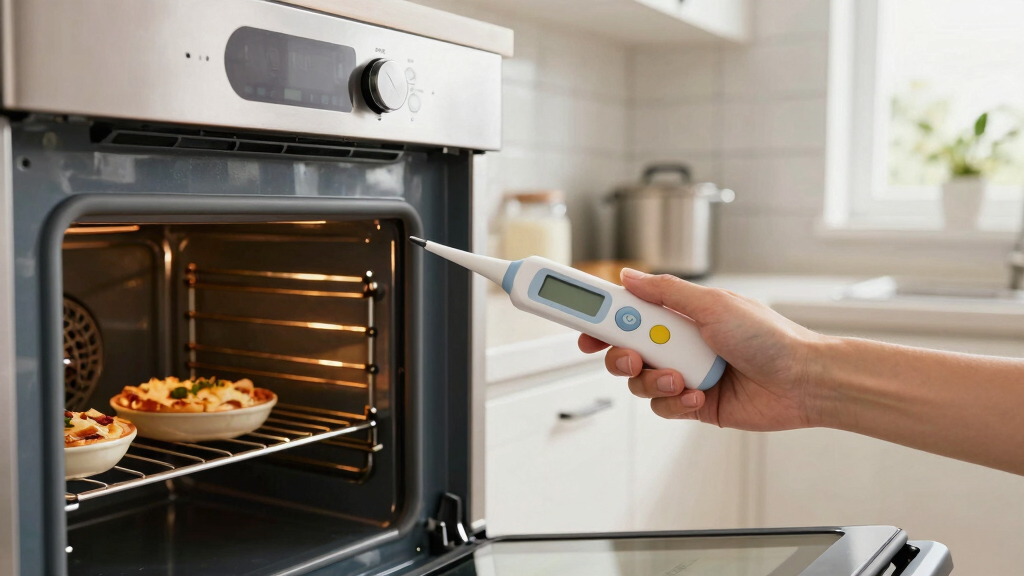
- Gather a reliable oven thermometer. Preferably a dial or digital model designed for oven use. Place it in the center of the oven on a baking sheet.
- Preheat your oven to a specific temperature. For example, 350°F (180°C). Make sure the oven fully heats up—wait at least 15-20 minutes.
- Read the thermometer once the oven signals it’s ready. Wait for the temperature to stabilize, then note the reading.
- Compare the thermometer reading to the oven dial setting. Record whether it’s higher, lower, or matches.
- Repeat at different temperatures (e.g., 250°F, 400°F). This helps assess accuracy across your oven’s range.
For example, if you set to 350°F but the thermometer shows 370°F, your oven runs hot. If it reads 330°F, it’s running cold. Knowing this allows you to decide whether calibration is needed.

Efeng Large Dial Oven Thermometer for Gas & Electric Oven,Grill Cooking Safety Leave-in- NSF accurately Easy-to-Read Clearly Large Number Shows temperatures for Meat,Grilling or Cake Cooking Oven
- Temperature Range: 150℉ to 600℉
- Versatile Usage: For ovens, grills, smokers
- Display Type: Large, easy-to-read dial
As an affiliate, we earn on qualifying purchases.
As an affiliate, we earn on qualifying purchases.
Understanding the Comparison: Oven Dial vs. Actual Temperature
| Oven Dial Setting | Thermometer Reading | Difference |
|---|---|---|
| 350°F | 370°F | +20°F (hotter) |
| 350°F | 330°F | -20°F (cooler) |
| 400°F | 410°F | +10°F |
This table shows how your oven’s dial can mislead you. A difference of just 10-20°F might seem small, but it can make a huge difference in baking times, browning, and doneness.
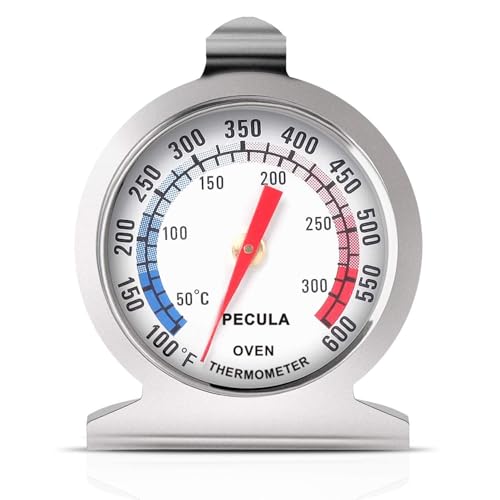
Stainless Steel Oven Thermometer 50-300°C/100-600°F, Analog Instant Read, Battery-Free Kitchen Cooking Thermometer, Hook & Stand Design Food Thermometer for Oven, Grill, Smoker, Fryer
- Precise Temperature Range: 50–300°C / 100–600°F
- Clear Dual-Color Dial: Blue and red indicators for easy reading
- Flexible Placement Options: Hook and stand for versatile positioning
As an affiliate, we earn on qualifying purchases.
As an affiliate, we earn on qualifying purchases.
Can You Fix It? How to Calibrate Your Oven for Better Accuracy
Many modern ovens allow you to calibrate the temperature yourself, often through internal controls or digital settings. Check your manual for instructions. If you find your oven runs hot or cold consistently, a simple calibration can bring the actual temperature closer to the dial setting.
Here’s a quick guide:
- Preheat to a known temperature (say, 350°F).
- Use your thermometer to check the actual temperature.
- Follow your oven’s calibration procedure—usually a combination of pressing buttons or turning a control knob.
If calibration isn’t possible or doesn’t work, a professional repair might be necessary. Sometimes, the sensor or heating elements need replacing.
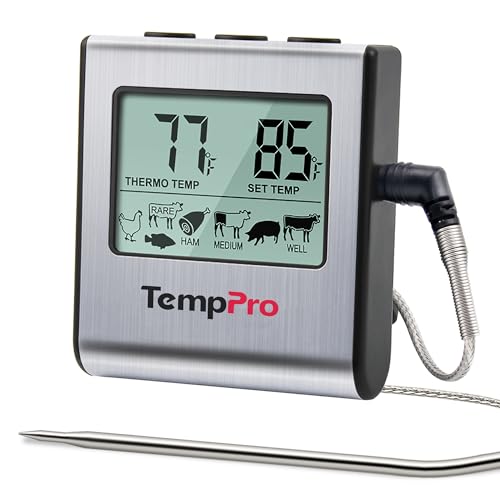
TempPro TempTrack Large LCD Digital Meat Thermometer for Cooking
- Cook Mode with USDA Settings: Preset and customizable temperature settings
- Timer and Alarm: Up to 99h 59m with alert notification
- High Temperature Resistance: Probe withstands up to 716°F
As an affiliate, we earn on qualifying purchases.
As an affiliate, we earn on qualifying purchases.
Why Investing in a Good Oven Thermometer Pays Off
Buying a quality oven thermometer isn’t just about accuracy; it’s about peace of mind. Accurate readings mean you can trust your recipes. You avoid overbaking cookies or undercooking roasts. Plus, digital models with remote alerts can tell you if your oven’s temperature drifts—no more opening the door to peek.
For example, a digital thermometer with a probe can sit inside your oven, transmitting real-time data to your phone. That’s especially handy for slow roasting or delicate baking.
When to Recheck and How Often
Set a reminder once a year to verify your oven’s temperature. Also, check after any major repair or if your dishes start turning out inconsistent. Keep in mind, ovens can drift over time, especially if they’re overused or not calibrated.
If you notice your baked goods burn on the edges but stay raw inside, it’s a sign to check your oven’s accuracy.
Frequently Asked Questions
How often should I check my oven’s temperature?
At least once a year, or anytime your baked goods start turning out differently than expected. If you notice inconsistent results, it’s a good idea to test more frequently.
Can I calibrate my oven myself?
Many ovens have calibration controls accessible through the control panel or internal settings. Check your manual—if you’re comfortable with basic adjustments, you can do it yourself. Otherwise, a professional can help.
What’s the best type of oven thermometer for home use?
Digital thermometers tend to be more precise and easier to read, especially in low-light or busy kitchens. High-quality analog models work well too, just make sure they’re oven-safe and accurate.
Why does my oven seem off even after calibration?
Over time, sensors can drift again, or heating elements may become less efficient. If calibration doesn’t fix the issue, consider professional repair or replacing the sensor.
Are built-in oven temperature displays reliable?
Not always. External oven thermometers give a more accurate snapshot of actual temperature, which is why testing with a separate thermometer is recommended.
Conclusion
Your oven’s dial is a rough guide, not gospel. Regularly verifying its temperature with a simple thermometer can save you from burnt edges, raw centers, or disappointing baked goods. When your oven’s heat matches your recipes’ needs, cooking becomes a reliable art, not guesswork.
So, grab a thermometer, set it in the oven, and see what’s really happening behind the dial. Your future baked goods—and your patience—will thank you.
Baby shower & registry season Picks
baby registry must-haves
As an affiliate, we earn on qualifying purchases.