
TL;DR
Open a free Amazon Business account
Business pricing, bulk buying and tax-exempt orders.
Create a free accountAs an affiliate, we earn on qualifying purchases.
Instant-read thermometers give quick, precise readings for checking doneness at the end of cooking. Leave-in probes monitor temperature continuously during long cooks like roasting or smoking. Use each tool where it excels for best results.
Use an instant-read thermometer for quick, accurate checks at the end of cooking or when testing multiple spots.
Deploy a leave-in probe thermometer for long, slow cooks like roasting or smoking, where continuous monitoring prevents overcooking.
Modern wireless models with smartphone alerts can save time and reduce guesswork during lengthy cooks.
Calibrate your thermometers regularly with ice or boiling water to maintain accuracy.
Choose features like response time, durability, and connectivity based on your cooking habits to get the best results.
What makes instant-read thermometers perfect for quick checks
Instant-read thermometers are your kitchen’s speed dial. They give a quick, accurate snapshot of your food’s temperature—typically within 2 to 5 seconds. Imagine stabbing a probe into a thick steak, then pulling it out to see it’s 130°F—perfect for searing or finishing. These devices excel when you need a fast answer without fuss.
For example, after grilling a burger, you can verify whether the inside hits 160°F without breaking your rhythm. They’re also great for testing multiple spots—checking the thickest part of a roast or the center of a pie. But remember, they’re meant for short-term use; prolonged heat exposure can damage their sensors. This quick response time is crucial because it allows you to make immediate adjustments—like removing a steak from heat once it reaches the perfect temperature—preventing overcooking. However, the tradeoff is that they aren’t designed for continuous monitoring, so relying on them for long cooks can lead to inaccuracies or device damage, which is why they’re best suited for quick checks rather than ongoing measurements.

Alpha Grillers Instant Read Meat Thermometer Digital, Cooking, Food, Grill
- Instant Read Response: 2-second temperature reading
- Versatile Use: Suitable for grilling, baking, and more
- Easy-to-Read Display: Bright backlit digital screen
As an affiliate, we earn on qualifying purchases.
As an affiliate, we earn on qualifying purchases.
Why leave-in probe thermometers are your long-term cooking allies
Leave-in probe thermometers stay in the food while it cooks, continuously tracking internal temperature. Think of them as your kitchen’s surveillance cameras—they keep an eye on things without you lifting the lid. These probes are often wired or wireless, with digital displays or app connections. They’re ideal for slow cooks, roasting, or smoking, where maintaining a precise temperature over hours matters.
Picture a brisket in the oven, slowly climbing toward 195°F. The leave-in probe alerts you the moment it hits your target, preventing overcooking. They’re built for durability and consistency, with materials that withstand high heat and repeated cleaning. This continuous monitoring is vital because it provides real-time data, allowing you to make adjustments during long cooking processes. For instance, if the temperature plateaus or rises too quickly, you can intervene early. The tradeoff, however, is that these devices can be more expensive and require setup before cooking. They also need to be carefully calibrated and maintained to ensure ongoing accuracy, making them a bit more involved but invaluable for complex, lengthy recipes where precision is paramount.

ThermoMaven Sub-1G Smart Wireless Meat Thermometer with Standalone Base
- Smart Display with Control: Real-time temperature readings and settings
- Easy One-Click Setup: Quickly connect probe and pair device
- Long-Range Connectivity: Monitor from up to 3000 feet away
As an affiliate, we earn on qualifying purchases.
As an affiliate, we earn on qualifying purchases.
Comparison table: When to grab instant-read vs leave-in probes
| Use Case | Instant-Read Thermometer | Leave-In Probe Thermometer |
|---|---|---|
| Quick check at end of cooking | Yes | No |
| Monitoring during slow or long cooks | No | Yes |
| Testing multiple spots quickly | Yes | No |
| Maintaining a target temperature | No | Yes |
| Best for grilling, searing | Yes | No |
| Best for roasting, smoking | No | Yes |

0.5 Sec Instant Read Meat Thermometer Digital for Cooking, Red
- Fast Reading Speed: 0.5 seconds for quick results
- High Precision: ±0.5℉ accuracy with professional sensor
- Temperature Lock: Hold temperature reading easily
As an affiliate, we earn on qualifying purchases.
As an affiliate, we earn on qualifying purchases.
When to reach for each thermometer: real scenarios
Imagine you’re preparing a prime rib for a holiday dinner. You’d probably use an instant-read thermometer at the end—piercing the roast quickly to check if it hits 130°F for medium rare. Once it’s done, you remove it from heat, and the quick check confirms perfection.
Now, think about smoking a brisket over several hours. A leave-in probe becomes your best friend here. It keeps tabs on internal temp, alerting you when it hits 195°F, so you don’t have to open the smoker repeatedly. Each tool shines in its own moment. The instant-read provides rapid confirmation, essential for final doneness checks, while the leave-in probe offers ongoing data, which is crucial for maintaining consistent internal temperature during lengthy processes. Using both appropriately ensures your meat is cooked to perfection without guesswork or overcooking.
ThermoMaven Sub-1G Smart Wireless Meat Thermometer with Standalone Base
- Smart Display with Control: Real-time temperature readings and settings
- Easy One-Click Setup: Quickly connect probe and pair device
- Long-Range Connectivity: Monitor from up to 3000 feet away
As an affiliate, we earn on qualifying purchases.
As an affiliate, we earn on qualifying purchases.
What features should you look for in a thermometer?
- Fast response time (under 3 seconds for instant-read)
- Accurate readings (within 1-2°F)
- Durability—especially for leave-in probes exposed to heat and cleaning
- Easy to clean, food-safe materials
- Wireless connectivity for smart models
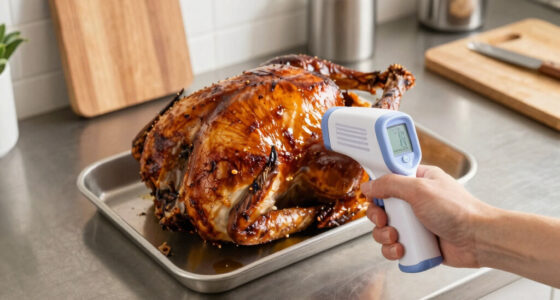
For example, a wireless model with a long probe reaches deep into a turkey without opening the oven. It alerts you on your phone when ready, minimizing guesswork and fuss. Choosing a thermometer with quick response times and durable construction ensures reliable measurements, while wireless features add convenience for multitasking during long cooks. These features matter because they directly impact your ability to get accurate readings and maintain consistent results, especially in busy or complex cooking scenarios.
FAQs: Your quick answers about these thermometers
Q1: Which thermometer is more accurate? Both can be accurate if used correctly. Instant-read thermometers give precise readings in seconds, while leave-in probes provide continuous data that’s reliable for long cooks.
Q2: Can I use an instant-read thermometer for long cooking? Not ideally. They’re designed for quick checks and can be damaged or give false readings if left in heat for too long. Using them repeatedly for the same purpose can also lead to wear and inaccurate results over time.
Q3: Are wireless thermometers worth it? Absolutely, especially if you cook large cuts or do a lot of smoking. They let you monitor from a distance, saving you time and effort, and often provide alerts that prevent overcooking or undercooking.
Q4: How do I calibrate my thermometer? Use the ice water method (32°F/0°C) or boiling water method (212°F/100°C at sea level). Follow your device’s instructions for best accuracy. Regular calibration ensures your readings remain trustworthy, especially important for precise recipes.
Q5: What features matter most? Response speed, accuracy, durability, ease of cleaning, and connectivity should guide your choice based on your cooking style. Prioritizing these features helps you select a thermometer that fits your needs and ensures consistent, reliable results.
Conclusion
Picking the right thermometer for each task turns guesswork into precision. Think of the instant-read as your quick snapshot tool, and the leave-in probe as your long-term assistant. The next time you cook that perfect roast or brisket, you’ll know exactly which gadget to reach for—and why.Grilling season Picks
grills
As an affiliate, we earn on qualifying purchases.