
TL;DR
Listen free for 30 days with Audible
Thousands of audiobooks and originals — cancel anytime.
Start your free trialAs an affiliate, we earn on qualifying purchases.
Thermocouples respond faster and handle extreme temps but are less precise in moderate ranges. Thermistors offer higher accuracy within a narrower range but are slightly slower. Your choice depends on your specific temperature monitoring needs.
Thermocouples respond faster—within milliseconds—ideal for real-time, high-temperature measurements.
Thermistors provide higher accuracy—often within 0.1°C—best suited for moderate temperatures and precision tasks.
Choose thermocouples for extreme environments; thermistors for controlled, moderate conditions.
Both sensors benefit from recent tech upgrades like wireless connectivity and better materials.
Matching your environment and needs with the right sensor ensures accurate, timely readings.
How Do Thermocouples and Thermistors Actually Measure Temperature?
Thermocouples generate a tiny voltage when exposed to a temperature difference—think of it as a natural electrical response to heat. This voltage is proportional to the temperature gradient, which means that as the heat increases, so does the voltage, allowing for measurement. Thermistors, on the other hand, change their electrical resistance as their temperature shifts. This change is often non-linear but highly predictable within their range. For example, a thermocouple in a furnace quickly detects high heat because the voltage change is immediate and significant, making it ideal for rapid, high-temperature environments. Conversely, thermistors are sensitive to small resistance changes, translating into very precise readings at moderate temperatures. Understanding this core difference matters because it influences how each sensor responds to environmental conditions, their susceptibility to interference, and their suitability for different applications. Thermocouples are less affected by wiring length and electromagnetic noise, making them more reliable in industrial settings, while thermistors’ high sensitivity makes them perfect for detailed, stable measurements in controlled environments.

Thermocouple Thermometer Digital K Type Thermocouple,Dual Channel Thermocouple Tester(-238~3212℉) with 4 K-Type Thermocouples LCD Display Temperature Tester for K/J/T/E/R/S/N Type
- Functional Features: Hold, Max, Min, Avg, auto-off, dual display
- Measurement Compatibility: Supports K/J/T/E/R/S/N thermocouples
- Includes Probes: Two K-type probes and stainless steel sensors
As an affiliate, we earn on qualifying purchases.
As an affiliate, we earn on qualifying purchases.
Speed Matters: Which Sensor Gives Faster Readings?
When speed is your priority, thermocouples usually lead the pack because of their rapid response time. They respond within milliseconds—sometimes as fast as 1 to 10 milliseconds. This quick response is critical in scenarios where temperature changes happen suddenly, like in high-temperature industrial furnaces, metal forging, or scientific experiments where even small delays can impact results. The rapid voltage change in thermocouples allows for near-instantaneous adjustments, minimizing lag and enabling precise control over processes that are sensitive to temperature fluctuations. Thermistors, while still fast, generally take around 10 to 50 milliseconds to stabilize after a temperature change. This slight delay might seem negligible in everyday use, but in fast-paced industrial environments or high-precision scientific work, it can be significant. The tradeoff is that thermistors’ slower response is often compensated by their higher accuracy, which is more important in applications where steady, precise readings are essential rather than immediate feedback.

Sper Scientific Large Display Temperature Monitor 800116 – High Accuracy Thermistor Probe, Extra-Large Readable Display, Waterproof, 19” Probe with Clamp for Food Processing, Boilers & Grain
- Large Display: 1.5-inch high digits for easy reading
- High-Accuracy Probe: 19-inch thermistor with clamp
- Waterproof Design: IP67 rated for wet environments
As an affiliate, we earn on qualifying purchases.
As an affiliate, we earn on qualifying purchases.
Accuracy Showdown: Which Sensor Is More Precise?
Thermistors often deliver higher accuracy within their operating range—sometimes within 0.1°C. This high level of precision is crucial in applications where small temperature deviations can lead to significant consequences, such as calibrating scientific instruments, controlling fermentation in brewing, or maintaining strict environmental conditions. Their resistance change is highly predictable and stable over time, which means they can be calibrated to provide consistent, reliable measurements for extended periods. However, this precision comes with a tradeoff: thermistors are sensitive to environmental factors like humidity and mechanical stress, which can cause drift over time if not properly maintained. Thermocouples, in contrast, typically have an accuracy of around ±1°C in standard setups. They are less precise but excel in measuring very high or very low temperatures where thermistors would be damaged or inaccurate. The key implication here is that if your application demands pinpoint accuracy within a moderate temperature range, thermistors are the superior choice. But if you need to measure extreme temperatures with acceptable precision, thermocouples are more suitable, even if they require careful calibration and more shielding from environmental noise.
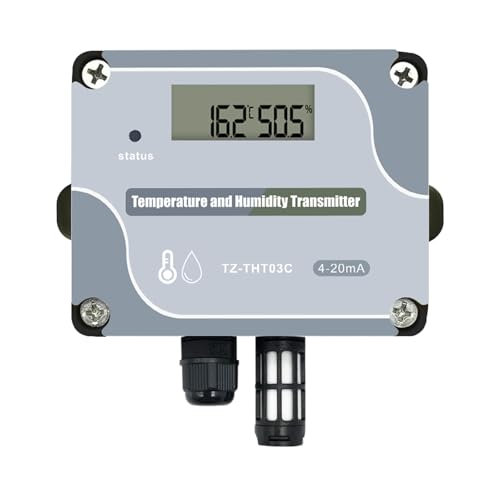
Tzone 4-20mA Temperature Humidity Transmitter Industrial Analog Temp Sensor
- Analog Signal Output: Strong anti-interference and high precision
- Compact Three-Wire System: Reduces weight and simplifies installation
- Wide Measurement Range: Temperature: -40°C to 125°C, Humidity: 5% to 95% RH
As an affiliate, we earn on qualifying purchases.
As an affiliate, we earn on qualifying purchases.
Temperature Range: What Can These Sensors Handle?
Thermocouples shine in extreme temperatures—think of industrial furnaces or metal melting—where temperatures can soar past 2000°C. Their construction with durable metal alloys allows them to withstand these harsh conditions without degrading, making them indispensable for high-heat applications. This wide temperature range provides a significant advantage in environments where other sensors would fail or require complex cooling systems. Thermistors are designed for more moderate conditions—up to about 150°C. They are widely used in household appliances, medical devices, and HVAC systems because their materials are sensitive and accurate within this range. If you’re measuring the heat of a stovetop, refrigerator, or room temperature, a thermistor offers reliable, precise readings without the need for extensive shielding or calibration. The key takeaway is that choosing between these sensors depends heavily on your environment—high-temperature industrial settings versus controlled, moderate environments—and understanding their operational limits helps prevent sensor failure or inaccurate readings.

ThermoMaven Sub-1G Smart Wireless Meat Thermometer with Standalone Base
- Smart Display with Control: Real-time temperature readings and settings
- Easy One-Click Setup: Quickly connect probe and pair device
- Long-Range Connectivity: Monitor from up to 3000 feet away
As an affiliate, we earn on qualifying purchases.
As an affiliate, we earn on qualifying purchases.
Durability and Cost: Which Sensor Lasts and Saves You Money?
Thermocouples are built for rugged environments. Constructed with metal alloys such as nickel or copper, they can withstand high shocks, vibrations, and extreme heat without losing functionality. This durability makes them cost-effective for industrial applications where sensors might be exposed to rough handling or harsh conditions. Their robustness often translates into longer service life and less frequent replacements, which saves money over time. Thermistors, however, tend to be more fragile because they are made from ceramic or polymer materials that can crack or degrade if mishandled or subjected to mechanical stress. Despite this fragility, they are generally cheaper to produce and easier to integrate into various electronic systems, especially for consumer products like smart thermometers or home climate controls. The tradeoff is that while thermistors are less durable, their lower cost and ease of use make them attractive for everyday applications where environmental stresses are minimal. Ultimately, your choice should consider the operating environment—harsh industrial vs. controlled household settings—and your budget constraints.
The Latest Tech: What’s New with These Sensors?
Recent technological advancements have significantly enhanced the capabilities of thermocouples and thermistors. Miniaturization has allowed for tiny sensors that can be embedded in complex systems, providing real-time data with minimal intrusion. Digital interfaces and wireless connectivity now enable seamless integration with smartphones, computers, and IoT networks, making remote monitoring and data logging easier than ever. For example, wireless thermocouples can send temperature readings directly to your device, alerting you instantly if temperatures go beyond safe limits—crucial for industrial safety or home automation. Material improvements, such as more stable thermistor compounds and high-performance thermocouple alloys, extend their operational lifespan and accuracy even in demanding conditions. These innovations mean that whether you’re an industrial engineer or a home hobbyist, you can rely on more durable, precise, and user-friendly sensors. The future of these technologies promises even smarter, more integrated temperature measurement solutions, expanding their applications across various industries and everyday life.
Frequently Asked Questions
Which is more accurate: thermocouple or thermistor?
Thermistors usually offer higher accuracy within their specific range—often within 0.1°C—making them ideal for precise tasks. Thermocouples are less precise but excel in extreme temperatures.Which sensor responds faster?
Thermocouples typically respond within 1 to 10 milliseconds, making them suitable for fast-changing environments like industrial processes or high-heat cooking.Can I use a thermistor for high-temperature cooking?
Generally not. Thermistors are best for moderate temperatures—up to about 150°C—and can be damaged or give inaccurate readings at higher temps. For high-heat, thermocouples are the safer choice.Are thermocouples more durable than thermistors?
Yes, thermocouples are designed to withstand harsh conditions like vibrations, shocks, and extreme heat. Thermistors are more fragile but more accurate in stable, moderate environments.How should I choose between them for my kitchen or workshop?
Consider the temperature range, needed response speed, and how precise your readings need to be. For quick, high-temp cooking or industrial use, thermocouples work best. For precise, steady measurements, thermistors are better.Conclusion
Picking the right sensor boils down to your specific needs—speed versus precision, high temperature versus moderate. Knowing these differences helps you avoid surprises and get trustworthy readings every time. When in doubt, consider what’s more critical: rapid feedback or pinpoint accuracy. Your perfect thermometer is out there—just choose wisely, and cook or measure with confidence.Grilling season Picks
grills
As an affiliate, we earn on qualifying purchases.