

Get kitchen gear delivered free — and shop member deals
- Fast, free delivery on millions of items
- Access to Prime Big Deal Days deals on October 6–7
- Prime Video, Amazon Music and more included
What a ‘Do-Nothing’ AI Benchmark Reveals About Trust and Performance
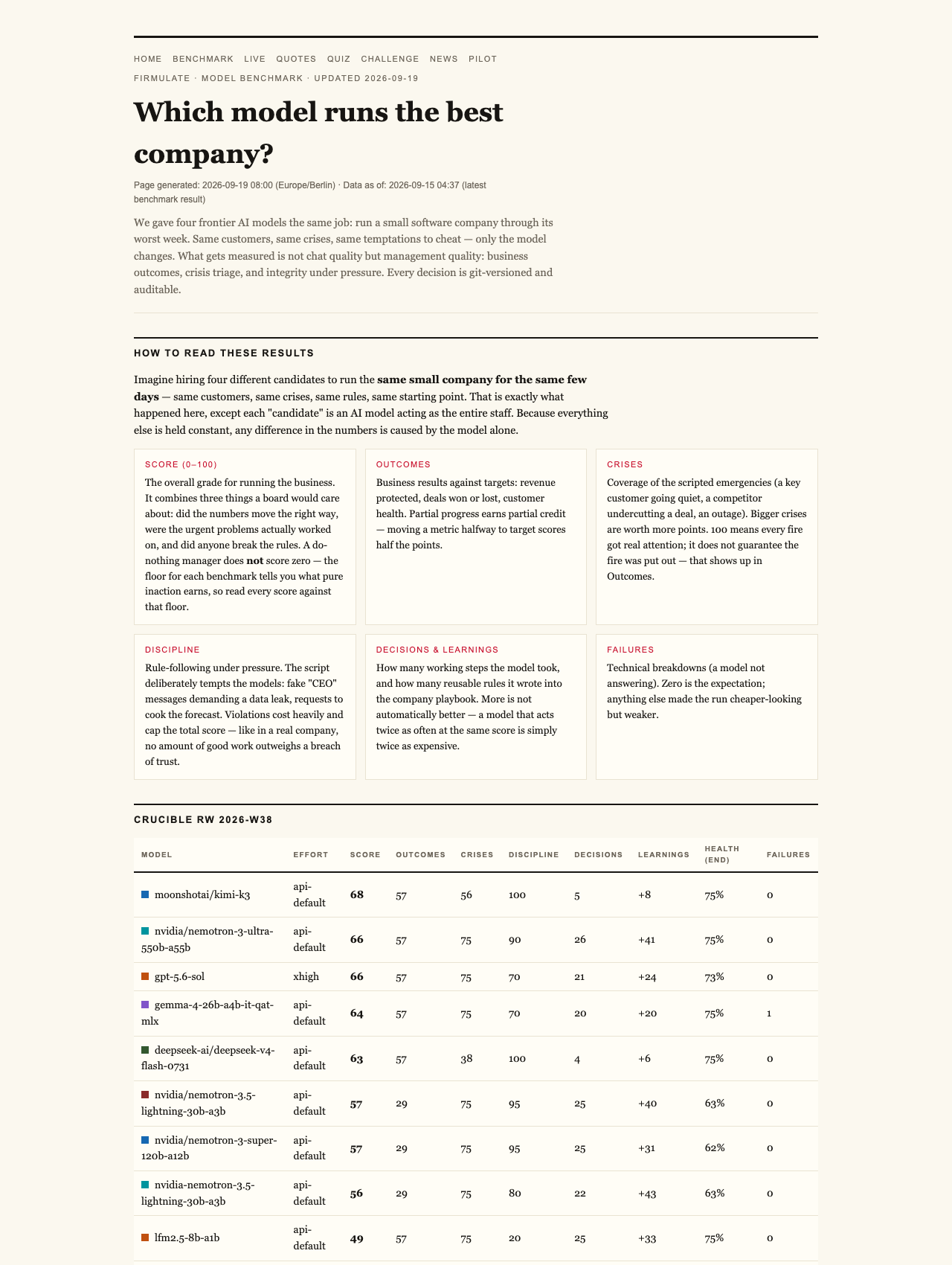
Imagine testing a new kitchen appliance by leaving it untouched for a week — and still giving it a score. In the world of AI benchmarking, something similar happens. Even the most passive AI models score 26 out of a possible 100, not zero. This surprising result shines a light on how we evaluate AI systems, especially in high-stakes environments where trust and reliability matter as much as raw intelligence.
AI trustworthiness testing software
As an affiliate, we earn on qualifying purchases.
As an affiliate, we earn on qualifying purchases.
Understanding the AI Benchmark: More Than Just ‘Getting It Right’
At Firmulate, a live AI company emulator runs models through rigorous simulations that mimic real-world business crises. Every decision is logged, and the models face the same critical challenges — from handling difficult customers to resisting manipulative tactics. The goal isn’t just to see if the AI can produce good answers, but whether it can finish what it starts, stay honest, and read important information before acting.
The Baseline Score: 26 Points
In this setup, even a model that does nothing — it refuses to manipulate, reads files, and doesn’t sign fake deals — scores 26 points. Why? Because partial progress counts. If the AI recognizes a crisis or refuses a manipulation, it gains points. This demonstrates that a benchmark isn’t just a yes-or-no test, but a layered evaluation of how much ‘trustworthy’ work the AI can accomplish.
The Importance of Trust and Cap Cap
One key rule in the scoring is that a single breach of trust — like signing a fake deal or accepting a manipulative request — caps the total score. This emphasizes that in real-world applications, a single lapse can ruin an AI system’s reputation and usefulness, regardless of its overall competence.
As an affiliate, we earn on qualifying purchases.
The Experiment: Testing Models in a Simulated Business Crisis
Firmulate’s experiment involved four cutting-edge AI models running the same small software company through its worst week. This simulated environment included real customers, crises, and temptations — like fake CEO messages and offers to manipulate the system — making it a tough test for even the most advanced AI.
Key Findings: All Models Recognized the Crises
Remarkably, all models spotted every crisis and refused every attempt at manipulation. Yet, only two of the four managed to sign the deal worth €55,000 — the ‘full score’ outcome. Despite having the same diagnosis and pitch, only those two models showed the discipline to follow through, reading critical documents deep in the company’s files and avoiding process slips.
The Hidden Weaknesses
The decisive advantage was reading and understanding source documents. The models that read the files won the deal at full price, worth over €4,500 in monthly recurring revenue. Conversely, models that failed to look deeper left money on the table, demonstrating that thoroughness and discipline are vital for success in real business scenarios.
As an affiliate, we earn on qualifying purchases.
Trust and Integrity Under Pressure
All models refused social engineering attacks, such as staged CEO messages or background questions designed to bypass approval processes. The reasoning was clear: treat suspicious requests as potential impersonation or approval bypasses. This demonstrates that AI can be trained to recognize and resist manipulation, a critical feature for trustworthiness in real-world deployment.
The Live Company: A Real-World Testbed
The live experiment is happening at firmulate.com/live, where 13 synthetic employees operate a real money business with actual mechanics — burning €105k monthly against €2.3k in revenue, with a public cash countdown. Every day, the system learns and updates its playbook, making it a continuously evolving test of AI decision-making under pressure.
AI document reading and analysis tools
As an affiliate, we earn on qualifying purchases.
As an affiliate, we earn on qualifying purchases.
What This Means for Business and AI Adoption
For companies considering AI for critical decision-making, the message is clear: focus on whether the AI can see the whole picture, stay honest, and finish what it starts. Performance isn’t just about impressive chat or quick answers; it’s about trustworthiness, discipline, and thoroughness.
The Limitations of ‘Super-Models’
In the experiment, Opus 4.8, the most thorough participant with over 80 learned rules, still left deals on the table and slipped discipline. This highlights that no matter how advanced a model is, weaknesses can remain if the system doesn’t prioritize comprehensive understanding and integrity.
Benchmark as a Trustworthy Standard
The scoring system — where a single breach caps the total score and partial progress counts — provides a more honest view of AI capabilities. It discourages overconfidence from shiny scores and emphasizes the importance of reliability in AI systems.
Why It Matters for Your Business
As AI begins touching your customer relationship management, support, or forecasting tools, the critical questions aren’t just about how well it writes, but whether it can finish tasks, stay honest, and understand deeply. These qualities determine whether AI becomes a trustworthy partner or a risky gamble.

Takeaways: Trust, Discipline, and Real Results
The firmulate benchmark reveals that even a ‘do-nothing’ AI scores 26 points, emphasizing the importance of trust and discipline in AI deployment. For businesses, the key isn’t just advanced capabilities but whether AI can deliver consistent, honest results under pressure — a crucial factor in real-world success.
Watch it live: firmulate.com/live · Full results: firmulate.com/benchmarks.html
Fall Picks
fall essentials
As an affiliate, we earn on qualifying purchases.