
TL;DR

Get kitchen gear delivered free with Prime
- Fast, free delivery on millions of items
- Prime Video, Amazon Music and more included
- Member-only deals all year
Dual and multi-channel timers allow you to track several dishes at once, preventing overcooking and freeing you from mental juggling. Modern options include smart features, customizable alerts, and easy setups—perfect for busy kitchens or complex meals.
Multi-channel timers simplify cooking multiple dishes by clearly separating each timer and alert.
Smart features like app control and voice commands add flexibility and reduce stress during busy cooking sessions.
Choosing the right number of channels depends on your typical meal complexity—more channels for elaborate dishes.
Comparison tables help distinguish between physical timers and app-based options, guiding your purchase decision.
Prepping and labeling timers, testing alarms, and customizing alerts make multi-tasking in the kitchen smoother.
Kitchen Timing Systems / Multi-Dish Control
Dual and Multi-Channel Timers: Tracking Several Dishes at Once
TL;DR: Dual and multi-channel timers let you track several dishes independently, preventing overcooking and freeing you from mental juggling. Modern options add smart controls, customizable alerts, and simple setups for busy kitchens, complex meals, and holiday cooking.
Potential reduction in cooking errors when each dish gets a separated timer and alert system.
Dual timers handle simple pairings; multi-channel models support elaborate spreads.
The best timer is not the fanciest one. It is the one that makes every dish’s deadline unmistakable.
What They Solve
Separate clocks for separate cooking jobs
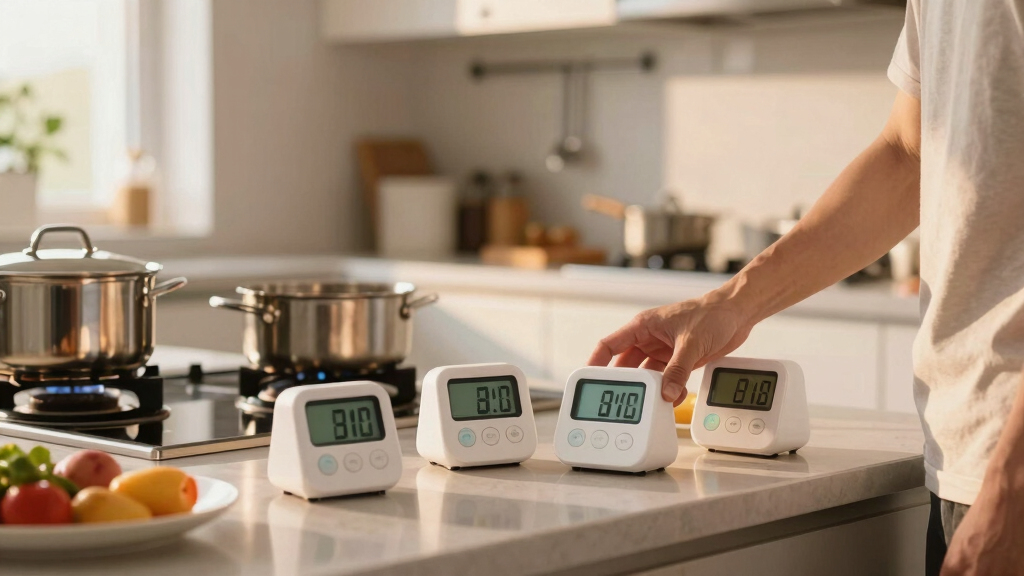
A dual timer tracks two cooking processes. A multi-channel timer expands that idea to three, four, six, or more independent countdowns, so pasta, chicken, cake, stuffing, and sauces do not compete for space in your head.
Each dish gets its own lane
Independent timers keep roast time, boil time, bake time, and rest time visibly separated, reducing confusion during crowded prep windows.
Different alarms prevent mix-ups
Custom sounds, flashing cues, and vibration alerts make it obvious which dish needs attention, even when several timers expire close together.
Less juggling, better timing
Instead of remembering every deadline, you can focus on doneness, seasoning, plating, and the parts of cooking that actually need judgment.
Workflow Diagram
From kitchen chaos to coordinated service
The value of a multi-channel timer is not just more countdowns. It is a workflow that turns overlapping cooking tasks into a readable sequence of decisions.
Assign
Give each dish or step a dedicated channel.
Label
Name timers by dish, burner, tray, or oven rack.
Differentiate
Use unique sounds, colors, or vibration patterns.
Monitor
Check status from the counter, phone, or smart display.
Finish
Pull, rest, stir, flip, or plate at the right moment.
Comparison Table
Physical timers vs. app-based timers
Physical models win on tactile certainty and durability. Smartphone apps win on flexibility, unlimited channels, remote monitoring, and integration with connected kitchen systems.
| Feature | Physical Multi-Channel Timer | Smartphone App Timer | Best Choice When |
|---|---|---|---|
| Timers Supported | Up to 10+ channels | Unlimited, depending on app | You cook many components at once |
| Ease of Use | ✓ Buttons and tactile controls | ~ Touchscreen interface | Hands are wet, busy, or gloved |
| Connectivity | ✗ Usually standalone | ✓ Bluetooth or Wi-Fi | You want remote monitoring |
| Alerts | ✓ Audible and visual | ✓ Sound, vibration, notifications | You need unmistakable dish-specific cues |
| Durability | ✓ Kitchen-ready casing | ~ Depends on phone placement | Steam, splatter, and heat are nearby |
| Smart Features | ~ Some premium models | ✓ Voice control, recipes, cloud sync | You use Alexa, Google Assistant, or recipe apps |
Buying Logic
Choose by meal complexity, not feature count
More channels are useful only when the interface stays clear. The sweet spot is enough lanes for your normal cooking load, plus one or two spare channels for resting, cooling, or last-minute sides.
Channel fit spectrum
Look for these controls
- Clear independent readouts for every active timer.
- Customizable alarm tones, volume, vibration, or flashing alerts.
- Large tactile buttons for fast setting during busy moments.
- Labels or color coding for dishes, burners, trays, or oven racks.
- Optional Bluetooth, Wi-Fi, app control, voice commands, or temperature probes.
Traceability Chain
How each timer turns into a better plate
The chain is simple: separate the task, clarify the alert, act at the right moment, and remove one more failure point from the meal.
What exactly are dual and multi-channel timers—and why do they matter?
Dual and multi-channel timers are devices designed to track multiple cooking processes at once. They support setting several timers, each independent, so you can keep tabs on different dishes without mixing up their times. Think of a dual timer as having two blindfolded chefs working in tandem—each aware of their own task. Multi-channel timers extend that to three, four, or even ten dishes, making complex meal prep more manageable. For example, during Thanksgiving, a multi-channel timer can alert you when the turkey hits the perfect temperature, the stuffing is ready, and the pies are baked—simultaneously. This prevents overcooking or burning, especially when multitasking in a busy kitchen. The importance lies in their ability to reduce the mental load on cooks, allowing for a more organized and stress-free process. Without these tools, managing multiple dishes often involves constant mental juggling, which increases the risk of errors, overcooking, or forgetting a dish altogether. Multi-channel timers essentially act as your reliable sous-chef, ensuring everything is done on time and freeing you to focus on other tasks or enjoy the moment.
As an affiliate, we earn on qualifying purchases.
How do multi-channel timers work—and what features make them useful?
Multi-channel timers operate by allowing you to set and monitor multiple timers independently, each associated with a specific dish or process. The core benefit is their ability to keep multiple tasks running without confusion, which is crucial when timing complex meals. For instance, setting a 20-minute timer for a roast, a 10-minute boil for potatoes, and a 30-minute bake for bread ensures each element is tracked accurately. Features like different alarm sounds for each channel help prevent mix-ups — you’ll instantly know which dish is ready based on the sound or visual cue. Advanced timers often incorporate additional functionalities such as Bluetooth connectivity, allowing remote monitoring via smartphone apps. This connectivity is especially important because it frees you from being tethered to the stove or oven, enabling you to multitask or step away without losing track of your timers. Durability and ease of use are also key—models with large, tactile controls reduce the risk of setting errors during busy moments. Some timers even include temperature sensors, adding another layer of precision for dishes that require both timing and temperature control. These features collectively help cooks maintain control, reduce stress, and ensure that each dish reaches perfection without constant supervision. The combination of multiple independent timers and smart functionalities means you can coordinate complex meal preparations with confidence, minimizing errors and optimizing your workflow.
As an affiliate, we earn on qualifying purchases.
What do recent tech advances mean for your multi-channel timer choices?
Recent technological innovations have transformed basic timers into sophisticated kitchen assistants that enhance precision and convenience. Integration with IoT (Internet of Things) technology and smartphone apps means you can start, pause, or check timers remotely, giving you greater flexibility and reducing the need to be physically present at the device. For example, during a busy dinner prep, you might check your phone to confirm if the fish is done, without rushing back to the stove. Voice control compatibility with Alexa or Google Assistant offers hands-free operation, which is especially useful when your hands are occupied or messy—allowing you to control timers simply by voice commands. These advances also include highly customizable alerts—such as vibrations, different sounds, or flashing lights—to ensure you notice each timer’s completion, even if you’re not near the device. Synchronization with recipe apps or smart kitchen systems helps keep your cooking process organized, reducing the chance of missed timers or overcooked dishes. Improved internal clock calibration and enhanced accuracy mean fewer false alarms or missed alerts, which is critical when timing is tight. These tech improvements make multi-channel timers more reliable, adaptable, and intuitive, helping both amateur and professional cooks achieve consistent results with less effort and stress. They also open new possibilities for integrating timers into a broader smart kitchen ecosystem, where various devices communicate seamlessly, creating a cohesive cooking environment that simplifies complex meal prep and enhances overall efficiency.
programmable multi-timer for cooking
As an affiliate, we earn on qualifying purchases.
As an affiliate, we earn on qualifying purchases.
How many timers do you really need? Picking the right number for your cooking style
Choosing the appropriate number of timers depends on your typical cooking style and the complexity of your meals. For simpler weeknight dinners, a dual timer might suffice—such as boiling pasta while roasting vegetables—since managing two simultaneous tasks is usually manageable. However, if you frequently prepare elaborate meals or host large gatherings, more channels become invaluable. A 4, 6, or even 10-channel timer can be a game-changer, providing dedicated timers for each dish or component, preventing overlaps, and ensuring everything is ready at the right time. For example, a Thanksgiving feast with multiple sides, mains, and desserts benefits from a multi-channel setup, ensuring no dish is forgotten or overcooked. The key is to evaluate your typical meal complexity: do you often cook multiple dishes at once, or just a few? Matching your needs with the right number of channels helps avoid unnecessary expense and complexity while maximizing efficiency. Overly complicated timers with many channels can become counterproductive if they are difficult to operate or understand. Therefore, it’s essential to balance your actual needs with the usability of the device. The goal is to have enough channels to cover your typical cooking load without overwhelming yourself with unnecessary features, ensuring a smooth and stress-free cooking experience.
As an affiliate, we earn on qualifying purchases.
Comparison table: Digital multi-channel timers vs. app-based timers
| Feature | Physical Timers | Smartphone Apps |
|---|---|---|
| Number of Timers Supported | Up to 10+ channels | Unlimited, depending on app |
| Ease of Use | Physical buttons, tactile controls | Touchscreen, app interface |
| Connectivity | None, standalone device | Wi-Fi or Bluetooth |
| Alerts | Audible, visual on device | Sound, notifications on phone |
| Customization | Limited to device options | Highly customizable (sounds, labels) |
| Portability | High, portable | Depends on device |
Physical timers excel in durability and simplicity, making them reliable workhorses that don’t depend on internet connectivity or batteries for smart features. They are straightforward, with tactile controls that reduce accidental missetting, and often preferred in environments where simplicity and durability matter most. The tradeoff, however, is that they lack the advanced customization and remote monitoring capabilities of app-based timers. Smartphone app timers, on the other hand, offer extensive flexibility—managing unlimited timers, customizing alerts, and monitoring from anywhere within Wi-Fi range. This makes them particularly attractive for tech-savvy cooks or those managing complex, multi-dish meals. The tradeoff is that app timers depend on your device’s power and internet stability, which can be a disadvantage during outages or if your device’s battery is low. Additionally, some users may find app interfaces overwhelming or less intuitive than physical controls. Ultimately, the choice between physical and app-based timers hinges on your cooking habits, comfort with technology, and the level of control you desire. Recognizing these differences helps you select a timer system that aligns with your kitchen style and ensures reliable, stress-free meal preparation.
Frequently Asked Questions
Can I use a single timer for multiple dishes?
A single timer can only track one dish at a time. For managing multiple dishes simultaneously, a multi-channel timer or multiple timers are necessary to ensure each dish hits its perfect moment.Are app-based timers reliable during a power outage?
App timers depend on your device’s power and Wi-Fi connection. For critical timing, physical timers with batteries are more reliable, especially in case of power interruptions.How do I prevent alarms from overlapping or becoming confusing?
Choose timers with customizable sounds or colors for each dish. You can also label each timer clearly and set distinct alarm tones to tell them apart instantly, which minimizes confusion during busy cooking moments.Are multi-channel timers suitable for professional kitchens?
Yes, especially models designed for commercial use. They support more channels, have robust build quality, and often include advanced features tailored for high-volume environments, ensuring reliability and efficiency at scale.What’s the biggest mistake home cooks make with multi-channel timers?
The most common mistake is not testing the timers beforehand or failing to label them. Both steps are crucial for avoiding confusion and ensuring that all dishes are properly timed, especially during hectic cooking sessions.Conclusion
Managing several dishes at once no longer means juggling mental notes or risking overcooking. With a well-chosen multi-channel timer, you bring order and precision to your kitchen. Imagine the aroma of perfectly cooked meals, each timed to perfection, while you relax and enjoy the process. The secret? Just a few well-placed timers and a little planning. Your next meal prep will be more efficient—and even enjoyable.
Halloween Picks
halloween
As an affiliate, we earn on qualifying purchases.