
TL;DR
Listen free for 30 days with Audible
Thousands of audiobooks and originals — cancel anytime.
Start your free trialAs an affiliate, we earn on qualifying purchases.
Cookie textures hinge on baking time, which controls how long moisture stays in the dough. Visual cues matter more than clock time, and ingredient tweaks can shift your results. This guide shows you how to get chewy, soft, or crispy cookies every time.
Imagine biting into a cookie that’s perfectly chewy, irresistibly soft, or satisfyingly crispy. You might think it’s just about the recipe, but in reality, baking time plays a starring role. The difference between a cookie that melts in your mouth and one that crunches like a biscuit boils down to just a few minutes in the oven—and what happens during those minutes.
In this guide, you’ll learn how to read your cookies’ signals, understand how baking times shape texture, and tweak ingredients for perfect results. Whether you want a gooey center or a golden crunch, knowing the ins and outs of timing makes all the difference.
How Baking Time Controls Cookie Texture — The Quick Breakdown
Baking time is the primary lever for controlling cookie texture because it determines how long moisture stays trapped in the dough. Shorter baking times—around 8 to 10 minutes—leave the centers slightly underdone, creating that chewy, moist bite. Extend baking to 12 to 15 minutes, and cookies become golden and firm, with crisp edges.
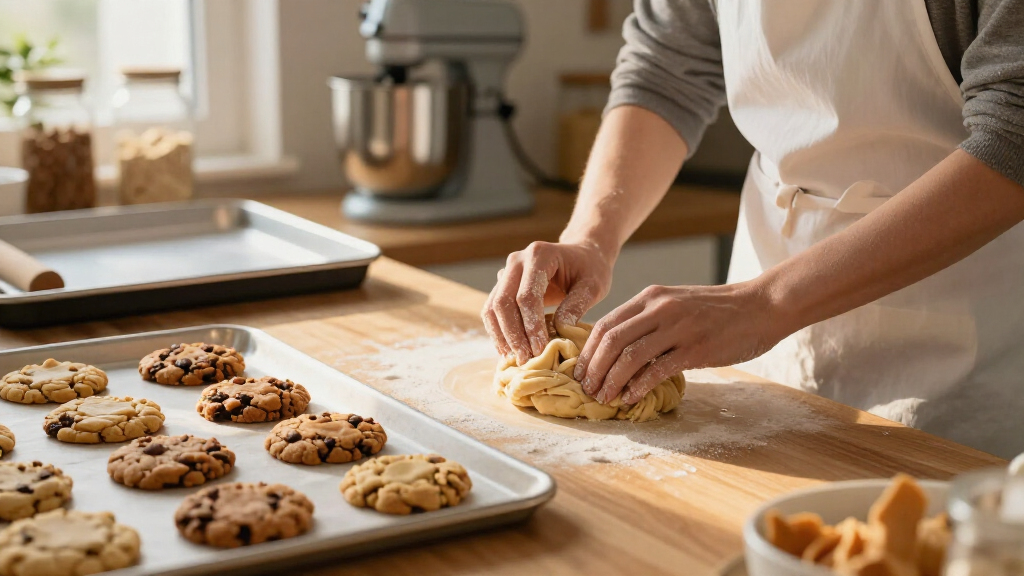
Visual cues matter more than the clock. Edges that are set but still soft in the middle signal a chewy cookie. Pale, uniformly set cookies lean toward soft and cake-like. Deep golden, firm edges with a crisp surface mark crispy cookies. According to Timer Tools, the typical ranges are:
- Chewy: 8–10 minutes
- Soft: 9–11 minutes
- Crispy: 12–15 minutes
Understanding these ranges helps you make informed decisions, but the real art lies in interpreting visual cues. For example, a cookie might be slightly under the minimum time but still achieve the desired chewy texture if your oven runs hot or if you prefer a softer bite. Conversely, overbaking slightly can turn a chewy cookie into a hard, brittle one. Recognizing the tradeoffs between time, appearance, and texture allows you to customize results based on your preferences and oven quirks.
As an affiliate, we earn on qualifying purchases.
Reading Visual Cues: How Do You Know When Your Cookies Are Done?
Instead of relying solely on time, watch your cookies. Chewy cookies will have edges that are just set but still look puffy and slightly glossy in the center. Soft cookies stay pale and look barely baked through. Crispy cookies turn a rich, golden brown all over with firm edges.
These visual cues are crucial because oven temperatures vary, and ingredients can influence baking speed. For instance, a batch of chewy chocolate chip cookies might look underdone at 9 minutes, but that’s actually perfect—they continue to cook on the hot baking sheet after removal, thanks to residual heat. Recognizing the right moment involves understanding that cookies often look less done than they are, especially for soft or chewy textures. Overbaking can lead to dryness and loss of desired chewiness, while underbaking may result in doughy centers.
Resting cookies 5 minutes on the baking sheet allows carryover heat to finish cooking the interior gently, preventing them from being raw or overly dry. This process emphasizes the importance of reading your cookies’ signals rather than clock-watching alone. Over time, you’ll develop an intuitive sense of when your cookies have reached the ideal state, balancing moisture, texture, and appearance.
As an affiliate, we earn on qualifying purchases.
The Role of Ingredients: How They Shift Baking Times and Texture
Ingredients are the secret sauce for texture. For chewy cookies, add more brown sugar, an extra egg yolk, or melted butter. These keep moisture in and promote chewiness. Soft cookies often use more leavening agents like baking soda or baking powder, plus ingredients like sour cream or cornstarch to make them tender. These ingredients influence not only the final texture but also how the dough responds during baking, affecting baking time and the appearance of the cookie.
For example, increasing brown sugar and butter creates a moist, caramelized flavor that enhances chewiness. Using ingredients like sour cream or cornstarch tenderizes the dough, making it softer and more delicate. On the other hand, higher white sugar content and longer baking times promote crispness by encouraging rapid moisture loss and browning. The tradeoff is that more moisture-retentive ingredients can extend baking time slightly, while ingredients that promote browning can accelerate the process. Understanding these interactions allows you to fine-tune your recipes for the desired texture, balancing flavor, moisture, and appearance.
Imagine a cookie with a rich caramel aroma—brown sugar and butter melting together—that’s a chewy result. Conversely, a golden, crackly cookie smells sweet, butter-rich, and toasted when crispy. Recognizing how ingredients influence both flavor and baking dynamics helps you make intentional choices to achieve your perfect cookie.
As an affiliate, we earn on qualifying purchases.
Conclusion
In conclusion, mastering cookie texture hinges on understanding how baking time interacts with ingredients, size, and oven variables. By paying close attention to visual cues and adjusting your baking approach accordingly, you can consistently produce cookies that are chewy, soft, or crispy to your liking. Remember, baking is both an art and a science—so don’t be afraid to experiment, note your results, and refine your technique. With patience and practice, you’ll develop an intuitive sense of perfect timing, making every batch a success. Happy baking!
As an affiliate, we earn on qualifying purchases.
Flea & tick season Picks
flea and tick prevention
As an affiliate, we earn on qualifying purchases.