
TL;DR
Get ready for Prime Big Deal Days — try Prime free
Exclusive member deals on October 6–7, plus fast free delivery. Cancel anytime.
Start your free trialAs an affiliate, we earn on qualifying purchases.
Cooking a turkey by weight requires precise timing and temperature monitoring. Use about 13-15 minutes per pound at 325°F, incorporate techniques like brining and covering, and always check internal temperature to prevent drying out.
Imagine carving into a golden-brown turkey, steam rising from juicy, tender meat. It’s the kind of meal everyone remembers. But getting there? That’s a balance of timing, technique, and a dash of patience.
If you’ve ever wrestled with a dry bird, you know how frustrating it can be. This guide simplifies turkey roasting by weight—showing you how long to cook it, how to keep it moist, and how to avoid drying out that precious meat. Ready to master the art of perfectly roasted turkey? Let’s get started.
Always measure your turkey’s weight accurately for precise timing.
Use a digital thermometer to check for 165°F in the breast—this is the best way to prevent dryness.
Brining, covering with foil, and resting are simple steps that keep turkey moist.
Roast at 325°F and plan for about 13-15 minutes per pound for unstuffed turkey.
Larger birds need a little extra attention—more resting and careful monitoring.
How to Calculate Your Turkey’s Perfect Roasting Time
Roasting times depend mainly on weight and whether the bird is stuffed or unstuffed. For unstuffed turkeys, the rule of thumb is about 13 to 15 minutes per pound at 325°F. For stuffed, it’s closer to 16 to 17 minutes per pound. This difference exists because stuffing adds mass and insulates the turkey, requiring longer cooking to ensure safety and doneness.
Calculating exact times based on weight helps prevent overcooking or undercooking, but it’s important to understand why these times matter. Overcooking leads to dry, tough meat, especially in the breast, while undercooking can be unsafe. Using a thermometer becomes essential — it’s the only way to confirm the turkey has reached a safe internal temperature while remaining juicy.
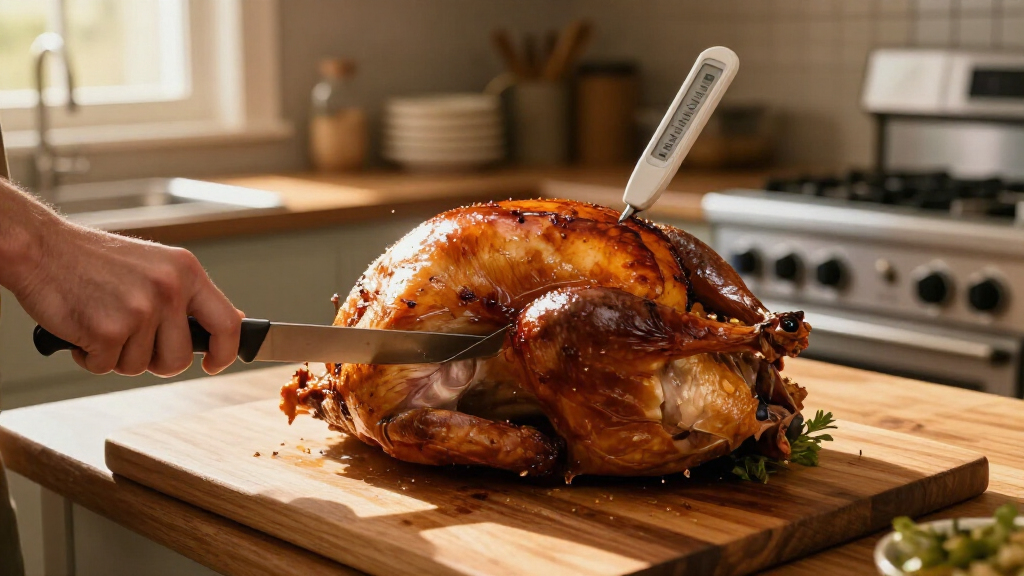
For example, a 14-pound unstuffed turkey will need approximately 3 hours at 325°F. Always verify with a meat thermometer—visual cues alone won’t guarantee safety or perfect texture. The internal temp should reach 165°F in the breast and 170-175°F in the thigh, indicating thorough cooking without overdoing it.
digital meat thermometer for turkey
As an affiliate, we earn on qualifying purchases.
As an affiliate, we earn on qualifying purchases.
Use a Meat Thermometer — Your Secret Weapon Against Dryness
Never guess doneness by color or time alone. A reliable digital meat thermometer is your best friend because it provides precise, real-time data on internal temperature. This accuracy is crucial because oven temperatures can vary, and turkey sizes differ. Inserting the thermometer into the thickest part of the breast and thigh helps you gauge whether the meat has reached a safe temperature without overcooking.
Once it hits 165°F in the breast, you’re essentially at the optimal point—safe and juicy. Removing the turkey at this stage and letting it rest ensures the juices, which tend to migrate towards the center during cooking, redistribute evenly throughout the meat. Resting for at least 20 minutes prevents the juices from escaping when you carve, which is one of the most effective ways to keep the meat moist and flavorful. Skipping this step often results in dry slices because the juices haven’t had time to settle.
Therefore, temperature monitoring combined with resting is not just about safety; it’s about maintaining the ideal moisture level and flavor profile, making your turkey succulent instead of dry or stringy.
As an affiliate, we earn on qualifying purchases.
Simple Tricks to Keep Your Turkey Juicy and Flavorful
Roasting a turkey without drying it out is easier with a few proven techniques that directly influence moisture retention and flavor development:
- Brine: Soaking the bird in a saltwater solution for 12-24 hours not only enhances flavor but also helps the meat retain moisture during cooking. The salt dissolves muscle proteins, which improves the turkey’s ability to hold onto water, resulting in juicier meat even if slightly overcooked.
- Cover with foil: During the second half of roasting, tent the turkey with foil. This creates a barrier that prevents the surface from drying out while still allowing heat to penetrate, maintaining a moist interior and crispy skin.
- Baste sparingly: Basting with pan drippings every 30 minutes can add flavor and moisture to the surface. However, opening the oven frequently causes temperature fluctuations, which can prolong cooking time and lead to dryness. Use this technique judiciously to balance moisture and oven heat stability.
- Rest the turkey: Resting allows juices to redistribute from the center to the outer meat. Cutting into the turkey too soon causes these juices to escape, resulting in dry slices. Proper resting time—about 20-30 minutes—ensures each slice remains moist and flavorful.
Implementing these techniques involves understanding the tradeoffs—brining adds prep time but yields moist meat; covering prevents surface drying but can soften skin if overused; basting enhances flavor but risks heat loss; and resting requires patience but guarantees juiciness. Balancing these methods according to your priorities will help you achieve a perfectly moist, flavorful turkey every time.
As an affiliate, we earn on qualifying purchases.
Frequently Asked Questions
How do I prevent my turkey from drying out during roasting?
Use a reliable thermometer, brine the bird beforehand, cover it with foil during the second half of roasting, and let it rest before carving. These steps lock in moisture and keep the meat juicy. Understanding why each step matters helps you adapt your technique—brining introduces additional moisture, covering prevents surface dehydration, and resting allows juices to settle, all of which work together to produce a moist, flavorful turkey.
What’s the best way to tell if my turkey is cooked perfectly?
The most accurate method is checking the internal temperature—165°F in the breast. Visual cues are unreliable because color and surface appearance can be misleading. Relying on a digital meat thermometer ensures you hit the perfect point where the turkey is safely cooked but still retains moisture, avoiding the common mistake of overcooking and drying out the meat.
How long should I cook my turkey based on its weight?
Plan for about 13-15 minutes per pound at 325°F for unstuffed turkeys, but remember that these are guidelines. The actual time can vary based on oven calibration, bird shape, and whether it’s stuffed. Using a thermometer to check the internal temperature at the 13-minute mark for each pound helps you fine-tune the cooking process, preventing over- or undercooking, and ensuring maximum juiciness and safety.
Can I cook a frozen turkey directly?
It’s safer and more effective to fully thaw your turkey before roasting—allow about 24 hours per 4-5 pounds in the refrigerator. Cooking from frozen can result in uneven cooking, with parts overdone while others remain undercooked. The longer, slower thawing process ensures even heat distribution and makes it easier to monitor internal temperature, reducing the risk of dryness or food safety issues.
Should I stuff the turkey or cook stuffing separately?
Cooking stuffing separately is generally safer and more controllable. Stuffing inside the bird can increase cooking time and create uneven heat distribution, which risks bacteria survival if not cooked thoroughly. Separately cooked stuffing allows you to monitor temperature precisely, ensuring both the turkey and stuffing reach safe and optimal temperatures, while also helping maintain moisture in the meat itself.
As an affiliate, we earn on qualifying purchases.
Conclusion
Perfectly roasted turkey hinges on timing, temperature, and a few smart techniques. Focus on the internal temp and give the bird time to rest. Your efforts will reward you with a juicy, flavorful centerpiece that everyone will remember.
Next time you pop that bird in the oven, picture the tender slices and rich aroma. That’s the magic of knowing your turkey’s weight and giving it just enough time.
NFL season / tailgating Picks
team gear
As an affiliate, we earn on qualifying purchases.