TL;DR

Get kitchen gear delivered free with Prime
- Fast, free delivery on millions of items
- Prime Video, Amazon Music and more included
- Member-only deals all year
Magnetic timers stick securely to metal surfaces like fridges, perfect for sleek, space-saving setups. Clip-on timers are versatile, attaching to handles, fabric, or textured surfaces. Choose based on your kitchen’s surfaces and your preference for flexibility.
Ever find yourself hunting for your kitchen timer, only to realize it slipped off the fridge or fell behind the toaster? The mounting style of your timer isn’t just a minor detail—it’s a game-changer for convenience and organization. Whether you prefer the sleek pull of a magnetic timer or the versatile clasp of a clip-on, your choice shapes how smoothly your cooking routine flows.
In this guide, you’ll discover which mounting style fits your kitchen’s surfaces, habits, and style. We’ll compare magnetic and clip-on timers with real-world examples, so you can pick the perfect match for your cooking space.
Magnetic timers are perfect for metal surfaces like fridges and oven doors, providing a sleek, space-saving solution.
Clip-on timers offer maximum flexibility, attaching to handles, fabric, or textured surfaces—great for dynamic kitchens.
Stronger magnets and multi-function timers are improving the reliability of magnetic timers, making them a dependable choice.
Always match your timer’s mounting style to your kitchen surfaces and your daily routines for seamless cooking.
Don’t forget to consider aesthetics—timers can be both functional tools and decorative accents.
Which Mounting Style Fits Your Kitchen?
TL;DR: Magnetic timers stick securely to metal surfaces like fridges and oven doors, perfect for sleek, space-saving setups. Clip-on timers attach to handles, fabric, hooks, and textured surfaces, making them better for flexible, move-as-you-cook kitchens.
Strong neodymium magnets make modern models more reliable on compatible metal surfaces.
Clips move between oven handles, apron pockets, utensil hooks, and mixing zones.
Both styles usually sit in the same budget range, with premiums for digital features.
The deciding factor is what your timer can actually grip.
Fridges, oven fronts, and metal cabinets are the sweet spot.
Handles, fabric, plastic, wood, hooks, and uneven surfaces.
Most digital models use AA, AAA, or button-cell batteries.
Choose by how your kitchen behaves
Mounting style is not a tiny feature. It decides whether your timer is visible, reachable, and still there when the sauce starts bubbling.
Clean counters, fixed position
Best for: stainless fridges, metal oven doors, and flat metal cabinets. It keeps timing visible without taking up prep space.
Move it with the task
Best for: baking, multitasking, and kitchens where the timer needs to travel from apron to oven handle.
Two mounts, one timer
Best for: households that want a fridge anchor most days and a portable clip during busier cooking sessions.
Quick comparison table
Magnetic timers win on sleek stability when the surface is right. Clip-on timers win when your kitchen has more handles, hooks, fabric, plastic, or wood than exposed metal.
| Feature | Magnetic Timer | Clip-On Timer | Practical Verdict |
|---|---|---|---|
| Best surfaces | ✓Metal fridge doors, oven fronts, metal cabinets | ✓Handles, fabric, plastic, hooks, textured surfaces | Match the mount to the material you touch most often. |
| Placement flexibility | ~Limited to magnetic-compatible surfaces | ✓Highly movable across prep, baking, and serving zones | Clip-on is the flexible pick. |
| Stability | ✓Excellent on flat metal, weaker on uneven metal | ~Strong on grippy surfaces, weaker on slick or thin edges | Both depend on contact quality. |
| Counter clutter | ✓Very space-saving | ✓Also counter-free when clipped nearby | Either can keep prep space clear. |
| Risk points | ✗Can slip if the magnet weakens or surface is textured | ✗Can fall if the clip grip is shallow or bumped hard | Test the exact attachment spot before relying on it. |
Decision flow
Start with the surface, then decide whether your routine rewards stability or movement.
Find your anchor
Look for the spot where you naturally glance while cooking.
Metal or mixed?
Flat metal favors magnetic. Handles and fabric favor clip-on.
Bump check
Choose the mount that stays put during real kitchen movement.
Fixed or roaming
Fixed routines prefer magnetic. Dynamic routines prefer clip-on.
Mounting performance at a glance
These directional scores translate the research into practical buying signals: surface compatibility, placement freedom, and everyday stability.
Best-fit spectrum
Trace the right choice
A timer is easy to choose when you connect surfaces, cooking habits, stability, and style in one chain.
Choose magnetic for flat fridges, oven doors, and metal cabinets.
Choose clip-on for handles, fabric, hooks, plastic, and wood.
Place the timer where your eyes already go during cooking.
Pick fixed for simmering and roasting, movable for baking and prep.
Minimal metal blends in; colorful clips can become useful accents.
Final fit guide
Use this as the quick buying rule: magnetic for reliable metal placement, clip-on for changing surfaces and portable reminders.
Choose magnetic if…
- You have a visible metal fridge, oven door, or cabinet.
- You want a sleek, space-saving timer that stays in one place.
- You prefer a fixed visual reference for longer cooking tasks.
- You can attach it to a smooth, flat surface with full magnet contact.
Choose clip-on if…
- Your kitchen has wood, plastic, fabric, hooks, or textured surfaces.
- You move between prep, stove, oven, and baking stations often.
- You want to clip the timer to an apron, handle, bowl edge, or utensil rail.
- You value flexibility more than a permanent anchor point.
What makes magnetic timers a strong choice for metal surfaces
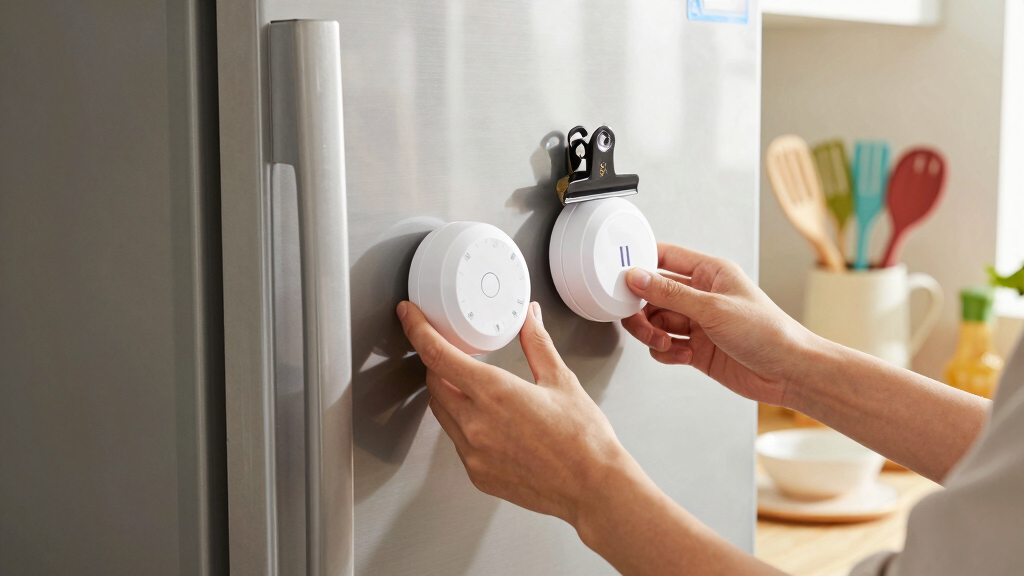
Magnetic timers are inherently designed to stick to metal surfaces—think fridge doors, oven handles, or metal cabinets. They use powerful magnets, often made from neodymium, to stay securely in place. This design makes them especially useful in kitchens where space is limited or where a clutter-free countertop is desired. The magnetic attachment ensures the timer remains visible and accessible without taking up counter space, promoting a tidy and efficient cooking environment.
However, the strength and reliability of magnetic timers depend heavily on the surface quality and magnet strength. On uneven or textured metal surfaces, the magnet may not make full contact, potentially causing the timer to slip or fall. This is a crucial consideration because it impacts safety and functionality—if the timer falls frequently, it can disrupt your cooking process or even cause damage. The tradeoff is that while magnetic timers are excellent for flat, smooth surfaces, their effectiveness diminishes on irregular or non-metallic surfaces, which could lead to frustration or the need for repositioning. Selecting a magnetic timer, therefore, involves evaluating your kitchen’s surfaces to ensure consistent performance and avoid unnecessary hassle.
In summary, magnetic timers are ideal for those prioritizing a sleek, space-saving solution on compatible surfaces, but they require consideration of surface quality and magnet strength to ensure consistent performance. Understanding these factors helps you decide if they will truly meet your needs without ongoing adjustments or frustrations.
As an affiliate, we earn on qualifying purchases.
Why clip-on timers give you freedom to attach anywhere
Clip-on timers offer unparalleled flexibility because their sturdy clamps or clips can attach to a wide variety of surfaces—from oven handles and apron strings to utensil hooks and even the edge of a mixing bowl. This adaptability means you’re not limited to metal surfaces, making clip-ons suitable for kitchens with diverse materials like plastic, fabric, or wood. Their design allows you to position the timer exactly where it’s most visible and convenient, which can significantly improve your cooking efficiency by keeping the timer within easy reach and sight. This flexibility can be especially beneficial in dynamic kitchens where surfaces change depending on the task or where space is at a premium.
Beyond versatility, clip-on timers often come with customizable or colorful designs, allowing you to match your kitchen decor or add a playful touch. The ability to move the timer around as needed means it can serve multiple functions—becoming a portable reminder that you can clip onto different items depending on the task at hand. This adaptability not only enhances convenience but also encourages better organization because you can reposition the timer based on your workflow, reducing the chances of forgetting or misplacing it.
However, this flexibility comes with some tradeoffs. The grip strength of the clip must be sufficient to hold on during busy cooking sessions, especially if bumped or jostled. On very slick or thin surfaces, the clip may slip or fail to grip adequately, which could lead to the timer falling or needing readjustment. This means that while clip-on timers excel in versatility, their reliability depends on the surface material and the clip’s design quality. Recognizing these limitations is important because it influences how securely the timer stays in place during vigorous cooking or handling. For kitchens with varied surfaces and frequent movement, choosing a clip-on timer with a strong grip and tested compatibility can make a noticeable difference in maintaining your workflow seamlessly.
As an affiliate, we earn on qualifying purchases.
How to choose based on your surfaces: a quick comparison table
| Feature | Magnetic Timer | Clip-On Timer |
|---|---|---|
| Best surfaces | Metal surfaces like fridge doors, oven fronts | Handles, fabric, plastic, textured surfaces |
| Placement flexibility | Limited to metal surfaces, but highly stable | Very versatile — can attach anywhere, including uneven or textured surfaces |
| Ease of repositioning | Quick, just pull and stick | Depends on clip strength, generally easy to reposition |
| Durability | Strong magnet, stable on flat surfaces, but may weaken over time | Secure grip, resistant to bumps but may slip on slick surfaces |
| Design options | Sleek, minimal, blends with metal surfaces | Colorful, decorative, customizable |
As an affiliate, we earn on qualifying purchases.
Which mounting style suits your kitchen: real-life scenarios
Think about how you cook. Do you have a shiny stainless fridge that’s always in your line of sight? A magnetic timer can attach there and stay put during busy mornings, ensuring you can glance at it without searching. Conversely, if your kitchen features open shelving, wooden cabinets, or fabric handles, a clip-on timer offers the advantage of being attachable to multiple surfaces, allowing you to move it seamlessly between tasks.
For example, a friend of mine keeps her clip-on timer clipped to her apron while baking bread. This setup allows her to move the timer effortlessly from her oven handle to her mixing bowl, keeping everything within arm’s reach. Meanwhile, her magnetic timer on the fridge provides a fixed point of reference for longer cooking tasks like simmering stews or roasting meats, where a stable, visible timer is essential. These scenarios illustrate that your choice depends on the surfaces you have and your need for flexibility or stability. Both styles can complement your workflow if chosen thoughtfully, but understanding your kitchen’s specific needs ensures you select the most effective mounting method for consistent, hassle-free timing.
As an affiliate, we earn on qualifying purchases.
Tips to pick the right timer for your kitchen
- Assess your surfaces: Consider whether your fridge or appliances are metal or if you have handles, fabric, or textured surfaces that require a different attachment method. This helps you select a timer that will stay secure and be easily accessible, preventing frustrations caused by weak attachments or frequent readjustments.
- Think about movement: Do you prefer a timer that stays fixed in one spot, or one you can move frequently? This influences whether a magnetic or clip-on timer is better suited to your habits, enabling you to adapt your timing setup to your workflow.
- Consider aesthetics: Do you want a timer that blends seamlessly into your kitchen decor, or one that adds a splash of color? Your choice can reflect your style while serving a functional purpose, making your kitchen both efficient and visually pleasing.
- Check the strength of magnets or clips: Ensure that the magnet is strong enough to hold on to your surfaces without slipping, or that the clip provides a secure grip even when bumping or jostling. This reduces the risk of losing timers during busy cooking sessions.
- Match features to your habits: Decide if you prefer digital timers with loud alarms or silent modes, and whether you want additional features like countdowns or memory functions that suit your cooking style. Matching these features to your routine ensures the timer enhances your cooking experience without unnecessary distractions.
Frequently Asked Questions
Which is more secure, magnetic or clip-on timers?
Magnetic timers are very secure on metal surfaces like fridges, provided the magnet is strong enough. Clip-on timers grip tightly onto handles or fabric, making them reliable on a wider range of surfaces. Choose based on your primary mounting surface.Can magnetic timers damage my refrigerator or metal surfaces?
Generally, no. Most magnets are designed to be gentle on surfaces. However, avoid placing them on painted or delicate surfaces to prevent scratches. Check manufacturer guidance if unsure.Are clip-on timers suitable for all surfaces?
They work well on handles, fabric, or textured surfaces. However, they can slip or fail to grip thin, smooth, or very slick surfaces. Test the clip’s strength on your specific material first.Which type is better for small kitchens?
It depends on your setup. Magnetic timers save counter space and stay put on metal surfaces, while clip-ons can be moved around easily, offering flexibility in tight spaces.Do digital timers with magnetic or clip-on mounts last longer?
Durability depends more on build quality and battery life. Mounting style mainly affects convenience and placement, not the timer’s lifespan.Conclusion
Your kitchen’s surface layout and your habits should guide your choice between magnetic and clip-on timers. A magnetic timer on the fridge keeps things simple and clean, while a clip-on offers portability and adaptability. Pick what suits your space—and your cooking style—and your timing will be smoother than ever.
Remember, the best timer is the one you actually use. So, think about where you’ll see it, reach for it, and rely on it every day. After all, a well-placed timer turns a busy kitchen into a well-oiled machine.
Fall Picks
fall essentials
As an affiliate, we earn on qualifying purchases.