
TL;DR
Infrared thermometers provide quick surface temperature readings, but they can’t measure internal food temperatures. Proper use and understanding their limits make them useful tools for home cooks.
Infrared thermometers have become a staple in many kitchens, prized for their speed and convenience. They let you scan a pan, a piece of meat, or a baked good without touching it. But how accurate are they? And what are their real limitations? Knowing this can save you from over- or under-cooking, or misjudging doneness.
If you’ve ever wondered whether an IR thermometer can tell you if your roast is perfectly cooked inside or if your frying oil is at the right temp, this guide is for you. We’ll break down what these gadgets can do, what they can’t, and give you practical tips for getting the most accurate readings in your kitchen.
Infrared thermometers measure only surface temperature, not internal doneness. Use them as a quick check, not a definitive test.
Proper calibration, understanding emissivity, and correct technique are critical for accurate readings.
Avoid reflective, shiny surfaces or measure on matte areas for best results.
Recent models with adjustable emissivity and laser targeting improve accuracy and ease of use.
Combine IR readings with other tools—like probe thermometers—for best cooking results.
Infrared Thermometers in the Kitchen: What They Can and Can’t Measure
TL;DR: Infrared thermometers deliver fast, contactless surface temperature readings. They are excellent for pans, griddles, ovens, grills, and quick scans, but they cannot measure internal food temperature or confirm doneness by themselves.
A heat camera for surfaces, not a window into food.
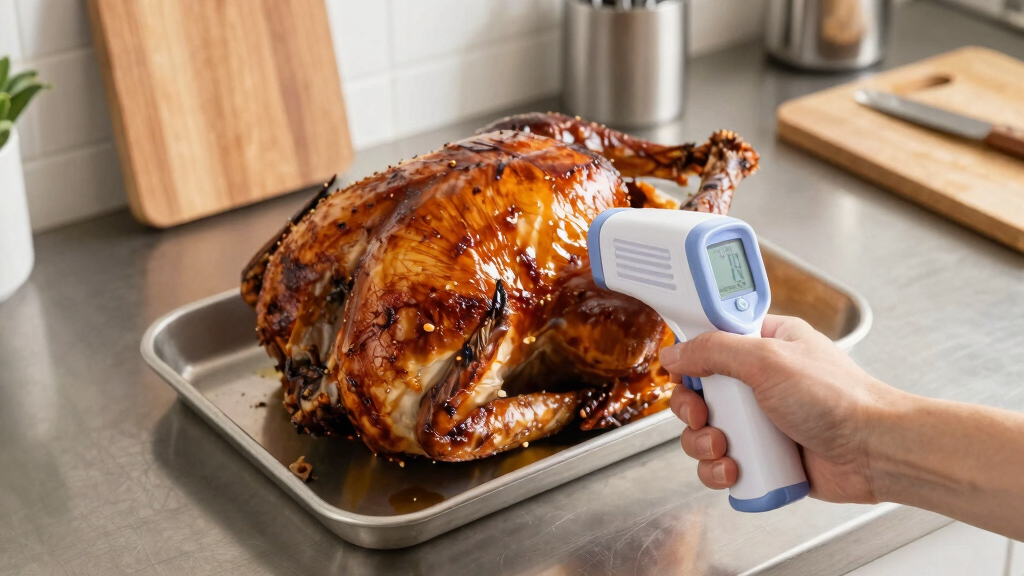
Infrared thermometers detect infrared radiation emitted by a surface and convert that energy into a temperature reading. The result is fast and useful, but it represents the surface the device sees.
Point at the target
The sensor reads heat radiating from the spot in view. Laser targeting helps aim, but the laser is only a pointer, not the measurement itself.
Radiation becomes a number
The thermometer estimates temperature from emitted infrared energy. Material type and surface finish affect how reliable that estimate is.
Use it as a quick check
A 375°F pan reading can guide searing or grilled cheese timing, but it cannot prove the center of a steak or chicken breast is done.
From fast scan to confident cooking decision.
The most reliable kitchen workflow treats infrared readings as early guidance, then uses direct measurement when doneness or safety matters.
Where infrared thermometers shine, and where they mislead.
They are safe, fast, and convenient around hot equipment. Their limitations appear when surface finish, angle, distance, or internal doneness enters the picture.
| Kitchen task | IR thermometer fit | Why it works or fails | Better companion tool |
|---|---|---|---|
| Check skillet before searing | ✓ Strong | Reads the cooking surface quickly before food goes in. | Visual oil shimmer or water-drop test. |
| Confirm roast center temperature | ✗ Poor | The surface may be hot while the center remains underdone. | Probe thermometer inserted into the thickest part. |
| Scan grill zones | ✓ Strong | Great for mapping hot and cool zones without touching grates. | Grill thermometer for ambient chamber heat. |
| Measure shiny stainless steel | ~ Tricky | Reflective surfaces can bounce infrared energy from elsewhere. | Matte tape, darkened spot, or contact probe. |
| Check soup or sauce temperature | ~ Limited | Steam, reflection, and surface cooling can hide the true liquid temperature. | Immersion probe thermometer. |
The reading is only as good as the surface.
Distance, angle, emissivity, and reflectiveness all influence the final number. Modern models improve consistency, but good technique still matters.
Different materials emit infrared radiation differently. Adjustable emissivity helps match the thermometer to the surface, especially with metal, plastic, ceramic, and cast iron.
Better sensors help, but they do not change physics.
Recent infrared thermometers add features that make aiming, logging, and surface calibration easier. They still remain surface readers.
Smart features worth having
Adjustable emissivity, laser targeting, improved low-temperature sensitivity, Bluetooth logging, and clearer distance-to-spot guidance all reduce guesswork in real kitchen use.
The answers that prevent the biggest mistakes.
Most IR thermometer errors come from asking the tool to do something it was not designed to do, or from aiming it at a surface that reflects more than it emits.
Can it measure internal meat temperature?
No. Infrared devices only measure surface temperature. Use a probe thermometer for internal doneness and food safety.
How do I handle shiny surfaces?
Measure a matte area, use a dark high-heat patch where appropriate, reduce reflection with angle, and adjust emissivity if the device allows.
Is it safe near hot pans and grills?
Yes. Contactless scanning is one of the best reasons to use IR thermometers around very hot cookware, burners, and grill grates.
Can it check liquids accurately?
Not reliably enough for precision cooking. Steam, reflection, and surface temperature shifts can mislead. Use an immersion probe for liquids.
How Infrared Thermometers Work in Your Kitchen
Infrared thermometers detect infrared radiation emitted by surfaces. When you point one at your skillet or baked bread, it measures the heat energy radiating off that surface. This info gets converted into a temperature reading almost instantly. Think of it as a camera that sees heat instead of light — fast, contactless, and often surprisingly accurate.
For example, you can quickly check if your pan is hot enough for searing by aiming the IR gun at the surface. It’s like having a heat radar for your kitchen. Just keep in mind: the device reads surface temperature, not what’s happening inside.
As an affiliate, we earn on qualifying purchases.
What Infrared Thermometers Can Do for Your Cooking
- Check if your pan is at the right temperature before adding ingredients, e.g., 375°F for searing steaks.
- Monitor the temperature of hot liquids or sauces from above without disturbing them.
- Ensure your baked goods are cooked evenly by measuring their surface temperature.
- Verify the heat of outdoor grills or burners without touching hot surfaces.
- Quickly scan multiple dishes or spots in your oven or fridge for temperature consistency.
Imagine you’re making a perfect grilled cheese. You want that golden crust with just enough heat to melt the cheese inside. An IR thermometer can tell you when your pan hits the ideal 375°F, saving you from guesswork or burnt sandwiches.
As an affiliate, we earn on qualifying purchases.
Why Infrared Thermometers Can Be Tricky to Use Correctly
Infrared thermometers measure only what’s on the surface. They don’t see inside your food. If you’re checking a roast, a quick scan of the outside won’t tell you if the center is cooked through. This limitation is significant because it can lead to a false sense of security—thinking your food is done when it’s not. Additionally, shiny, reflective surfaces like stainless steel pans or glazed ceramics can reflect infrared radiation, which skews the reading. This means you might think your pan is hotter or cooler than it actually is, leading to improper temperature adjustments.
For example, aiming an IR gun at a shiny frying pan might show an unexpectedly low or high temp because of reflection, not actual heat. Proper technique—like measuring at the right distance, angle, and on matte surfaces—makes a difference. Understanding these nuances helps you avoid misleading readings and make better cooking decisions.
Another tricky part: different materials emit infrared radiation differently, a property called emissivity. Most IR thermometers let you adjust this setting, but if you forget or guess wrong, your readings could be off by as much as 10°F or more. Recognizing that surface properties impact accuracy underscores why IR thermometers are best used as quick checks rather than definitive measurements, especially on shiny or reflective surfaces.
As an affiliate, we earn on qualifying purchases.
New Tech That Makes Infrared Thermometers More Reliable in the Kitchen
Recent IR thermometers feature improved sensors that give more consistent and accurate readings, even on tricky surfaces. Some models include adjustable emissivity settings, allowing you to calibrate for different materials like stainless steel, cast iron, or plastic.
Laser pointers help you aim precisely, especially on small or hard-to-see spots. Bluetooth or app connectivity lets you log temperature data or track trends over time—great for monitoring your oven’s performance or perfecting a recipe.
For example, a new IR gun with adjustable emissivity and laser targeting can help you quickly verify if your cast iron skillet is truly at 400°F before searing that steak, minimizing guesswork.
These technological improvements mean you can trust your IR thermometer more in real-world scenarios, but understanding how to use these features correctly remains essential for accurate readings.
As an affiliate, we earn on qualifying purchases.
The Big Takeaway: Use IR Thermometers Wisely in Your Kitchen
Infrared thermometers are excellent for quick surface scans but don’t rely on them for internal doneness. They’re best on non-reflective, matte surfaces, with proper distance and angle. Calibration and understanding emissivity are key for accurate results. Recognizing these limitations means you can avoid common pitfalls, like misjudging when a steak is cooked or a sauce is hot enough.
Use them as a tool in your arsenal—combined with probe thermometers or visual cues—to cook smarter, safer, and more consistently. Knowing when and how to interpret IR readings ensures you don’t make costly mistakes in your cooking process.
What Questions Do Home Cooks Usually Have About IR Thermometers?
- Can I measure internal temperature with an IR thermometer? No, IR devices only measure surface temperature. For internal temps, use a probe thermometer, which provides a direct measurement of the internal state, ensuring doneness and safety.
- How do I get accurate readings on shiny surfaces? Use a matte coating or apply a high-temperature paint designed for infrared measurements, or measure at an angle to reduce reflection. Adjusting emissivity settings can also help, but understanding that shiny surfaces reflect IR radiation is crucial for accurate readings.
- Are IR thermometers safe around hot surfaces? Absolutely—since they’re contactless, you avoid burns or damage, making them safer than probes when dealing with extremely hot objects.
- How close should I hold the thermometer? Follow the device’s instructions, usually a few centimeters to a couple of inches for best accuracy. Maintaining a consistent distance helps ensure comparable readings over time.
- Can I use IR thermometers to check liquids? Not ideal. Liquids have different emissivity and can reflect IR radiation, leading to inaccurate readings. Use a probe thermometer for liquids to get a true internal temperature.
Conclusion
Infrared thermometers are handy tools that can save you time and help prevent overcooking. But their surface-only focus means you need to know what they can and can’t tell you. Use them wisely, and they’ll become a trusted part of your kitchen toolkit.
Next time you’re about to sear a steak or check your oven’s heat, remember: a quick scan can guide you, but don’t rely solely on it. Pair it with good judgment, and you’ll cook smarter every time.